Showing posts with label Financial Reform. Show all posts

Thursday, October 20, 2011

Matt Taibbi: Bad Economist.

If by "people powered", Rolling Stone meant
"Goldman Sachs people" powered... Sure.
It's obviously fairly predictable that a guy who writes for Rolling Stone magazine wouldn't be the greatest economist in the world, but hey... I'm just a musician, and I turned my media production skills towards advocating on behalf of sound economics, right? Just saying, you never know.

However, recently a progressive guy I interact with from time to time on Twitter suggested that I read a Matt Taibbi article titled "My Advice to the Occupy Wall Street Protesters"... He starts off nicely by asserting that:
"The protesters picked the right target and, through their refusal to disband after just one day, the right tactic".
I beg to differ, Matt.

The protesters picked exactly the wrong target, actually. And their tactic of refusing to disband, as far as I can tell, has way more to do with the protesters desire to have a big 60's come-back party than any sane attempt at initiating real, systemic change.

Taibbi really gives up any hope of making sense by admitting:
"No matter what, I'll be supporting Occupy Wall Street. And I think the movement's basic strategy – to build numbers and stay in the fight, rather than tying itself to any particular set of principles – makes a lot of sense early on."
Here's the difference between me and guys like Taibbi. If the Wall Street protesters had occupied, say, the Federal Reserve, I'd more or less support their mission. I'd still be mocking them for being ridiculously privileged people - certainly by world standards, but even quite often by American standards - whining about how "poor" they are. I'd still be mocking the stupid signs, and confusion... but of course, in the alternate timeline where they're "Occupying" the Federal Reserve or the United States Congress, I have a feeling the signs wouldn't be quite so dumb.

Because... They'd have picked the right target.

The key here is, I wouldn't - and don't - support anyone "no matter what". The nice thing about being independent and focusing on critical thinking is that I get to support people based on the quality of their ideas and actions, so if their ideas and actions aren't good, I'm not emotionally tied to supporting the team when they're wrong. I've read a lot of Taibbi over the years, and while he's not the worst on some of these topics, he's stuck himself with team-thinking way too often, and here's a prime example.

In any case, he gives 5 pieces of advice, and each piece needs to be addressed individually... not only because I promised to do so via Twitter, but also because it really demonstrates why it's so important to think through ideas more clearly. At the very beginning of Frederic Bastiat's seminal essay, "What is Seen and What is Not Seen", he writes:
"There is only one difference between a bad economist and a good one: the bad economist confines himself to the visible effect; the good economist takes into account both the effect that can be seen and those effects that must be foreseen.

Yet this difference is tremendous; for it almost always happens that when the immediate consequence is favorable, the later consequences are disastrous, and vice versa. Whence it follows that the bad economist pursues a small present good that will be followed by a great evil to come, while the good economist pursues a great good to come, at the risk of a small present evil."
Taibbi - and let's be honest, most people - really doesn't think through his solutions. I think this is in part because he's emotionally invested in being angry at Wall Street, and in part because he's just not good at economic thinking. Let's go through his suggestions.
1. Break up the monopolies. The so-called "Too Big to Fail" financial companies – now sometimes called by the more accurate term "Systemically Dangerous Institutions" – are a direct threat to national security. They are above the law and above market consequence, making them more dangerous and unaccountable than a thousand mafias combined. There are about 20 such firms in America, and they need to be dismantled; a good start would be to repeal the Gramm-Leach-Bliley Act and mandate the separation of insurance companies, investment banks and commercial banks.
Ok... Let's set aside the fact that Taibbi asserts that 20 competing firms somehow is the equivalent of a monopoly. I agree with him that the limited market dominated by a handful of giant firms is a bad thing for everyone. It is a threat to our national financial security to be sure (virtually all centralized control is... that's a major theme of this blog time and time again), and while it's a bit hyperbolic, I think it's pretty fair to say that most of the big Wall Street titans are more dangerous than "a thousand mafias".

So I agree with Taibbi about the scale of the problem.

But Taibbi doesn't actually accurately understand where the problem comes from, and thus entirely misunderstands how to solve it. He claims they're "above the law and above market consequence"... But how did they get that way? Taibbi fails to address this, and therefore he makes innacurate conclusions about how to handle it.

First, he seems to think that simply re-instituting a separation of commercial and investment banking would solve the problem, but alas, Lehman Brothers & AIG for instance never had commercial divisions - yet they were instrumental to the collapse. So... How exactly is bringing back the Glass-Steagall Act going to fix that problem? It would not have prevented the financial meltdown in 2007 in the slightest, and there's plenty of documentation to prove that - not to mention pretty basic logic. If AIG wasn't subject to Glass-Steagall rules, and it was one of the chief direct recipients of bailout funds (and was used as a major argument for why we needed to bail out banks), then that by itself is enough to know why that argument is silly.

Also, simply having the government "dismantle" companies because we don't like them omits that the government and every single action it takes is politically directed.

So you always have to say; "Who decides"? In this case, who decides which banks get dismantled and why? The absurd utopian dream that guys like Taibbi are effectively supporting is that we'll just have some impartial, all-knowing, all-benevolent group of banking experts who will be able to determine which banks are ok and which aren't, and at what point the government should "dismantle" them.

But I wish for once some progressives would get serious about how government actually operates and about understanding the limits of knowledge that prevent their fantasy ideas from ever actually working.

In reality what happens is this. Whatever "czar" or board, or panel, or whatever you want to call it that ends up with the power to decide which banks survive intact and which don't will be staffed by real live human beings. These humans will have political affiliations, and in all likelihood, they will be closely tied with both the current politicians in power and with the very Wall Street firms they're about to oversee.

News flash: This is exactly why the SEC sucks.

So all of these insiders - and of course they must be insiders, because those who haven't worked on Wall Street or have ties to it won't be capable of understanding the systems they're trying to regulate in the first place - will be relatively easily manipulated by the biggest firms at the expense of weaker firms. So whatever "dismantling" occurs, we can be virtually assured that it will happen according to political will, and according to the wishes of the most well-connected players on Wall Street - not according to which banks "need" to be dismantled.

That means that - just like we've seen throughout the last 3 years of bailouts and exploding financial regulation - the big, well-connected firms will only get bigger and more powerful, and their smaller competitors who failed to successfully influence the regulations and regulators will die off.

This is seriously "Regulatory Capture 101".

It also gets to the heart of George Will's quote that I was recently made aware of more clearly expressing the Occupy Wall Street protester's bizarro logic: "Washington is grotesquely corrupt and insufficiently powerful."

If premise 1 is: Wall Street banks own the government, then there's no world in which it makes any rational sense to believe that you will somehow overwrite that ownership in passing new legislation when the political system and all the people operating it are the same.
2. Pay for your own bailouts. A tax of 0.1 percent on all trades of stocks and bonds and a 0.01 percent tax on all trades of derivatives would generate enough revenue to pay us back for the bailouts, and still have plenty left over to fight the deficits the banks claim to be so worried about. It would also deter the endless chase for instant profits through computerized insider-trading schemes like High Frequency Trading, and force Wall Street to go back to the job it's supposed to be doing, i.e., making sober investments in job-creating businesses and watching them grow.
There are a lot of assertions here that are simply absurd, the first of which being the idea that levying a tax on all stock trades is going to generate revenue for the government, period, not to mention enough revenue to cover the effectively $16 Trillion the Fed has dropped on the banking system over the last couple years. At some point, I'd really like for progressives to understand that taxation, especially on non-human entities like businesses - simply isn't a viable solution to most revenue related problems, because the tax is always either passed off onto consumers of products, or depresses transactions to a point where any gains in revenue you've made by raising rates you've lost (and then some!) by decreasing the number of transactions being taxed overall.

The point is, Taibbi is thinking essentially of only the best-case scenario where he's smarter about tax-law & finance than the collective intelligence of bankers at all of these giant financial institutions combined. I'm gonna go out on a limb here and bet that's a pretty poor assumption. These guys tend to live and breathe money-making and the finer points of arbitrage, and Matt Taibbi is a journalist. Ish.


Translation: The real consequence of such a tax would very likely be that transactions get funneled into some other area of banking that is - in all likelihood - more risky and more dangerous to the average investers 401k; perhaps through reducing the number of transactions per day and instead pursuing bigger individual transactions. Additionally, these kinds of taxes would mean the complete and utter destruction of businesses like eTrade which allow ordinary investors more control over their accounts.

If I had to bet, the end result would be a world where big banks had more consolidated power over people's investments, and the taxes themselves would be passed off in some way to consumers. See also: Bank of America's brand new debit card fees.

The more hilariously obnoxious side of all this is that it was all of the free market economists and their supporters like myself, who explicity warned the government NOT to bail out the damn banks in the first place!
Remember this?
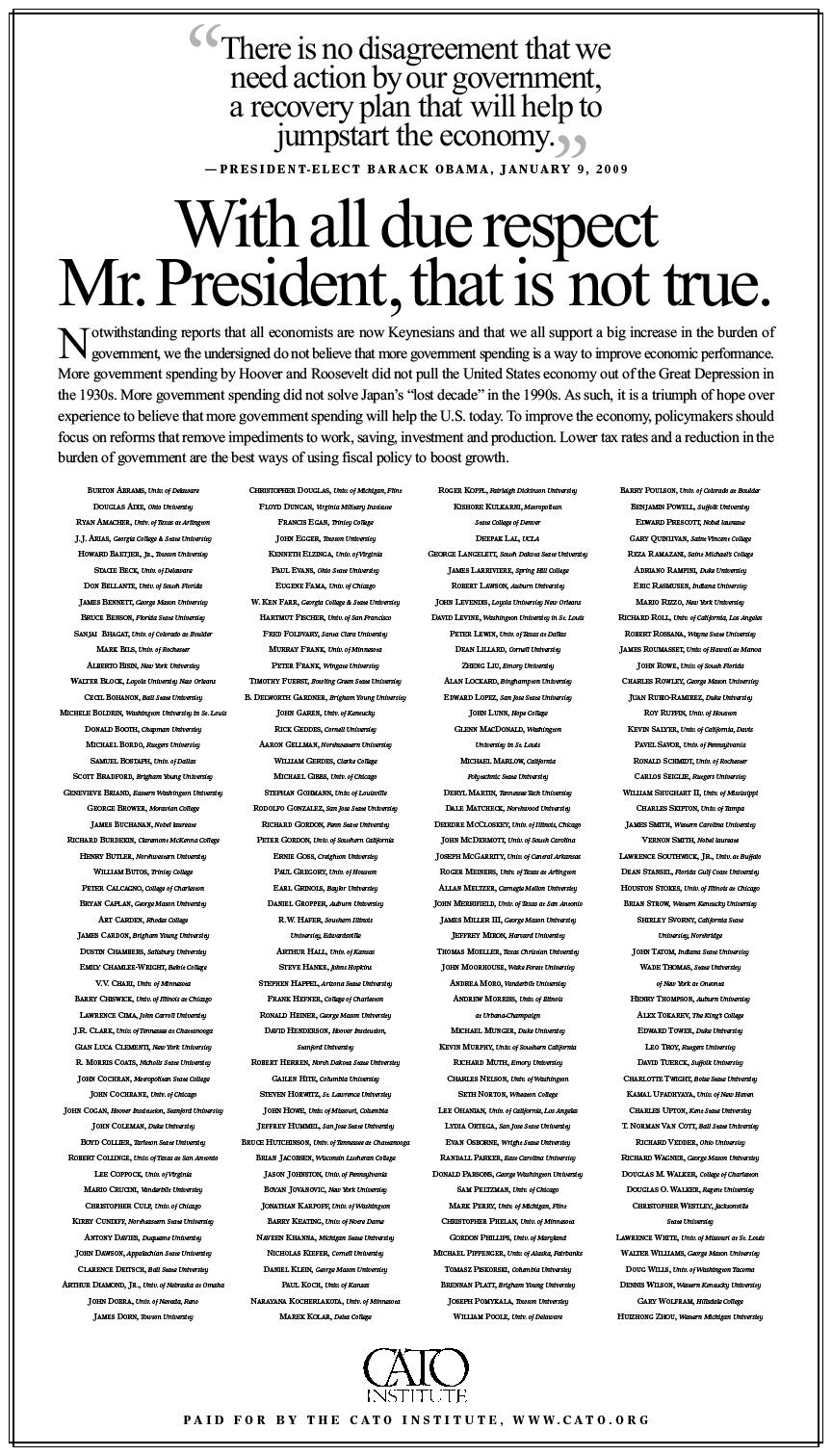
...cause I do.
If the government had just stayed out of this mess in the first place, it wouldn't have rewarded banks for bad behavior, thus creating even more moral hazard and screwing over the tax payers of the United States and Matt Taibbi nor the "Occupiers" would have anything to complain about. Bad banks would have gone under, their assets bought by solvent banks or written off via a bankruptcy process and the market could have recalibrated based on a more accurate understanding of real market value.

But nope... Why listen to good economists when you can listen to idiots, screw everything up and then write even worse laws when it becomes clear your policies have just created tons of problems?

And by the way, most of the banks did pay for their own bailouts - most, actually, didn't want to get bailout funds in the first place because there were so many strings attached, and thus they paid back the loans they were forced to take as quickly as possible. But anyway...
3. No public money for private lobbying. A company that receives a public bailout should not be allowed to use the taxpayer's own money to lobby against him. You can either suck on the public teat or influence the next presidential race, but you can't do both. Butt out for once and let the people choose the next president and Congress.
Yet another issue that wouldn't exist without the state intervening in the economy in the first place, but whatever, what's done is done... So let's talk about the logic here, shall we?

Setting aside the reality that this kind of a law would be a grotesque violation of the 1st Amendment which guarantees the right of everyone, including those who work for and run banks and other corporations, the right to petition their government and engage in any type of speech they wish to advocate ideas - including policies - that they agree with... I'd be a hell of a lot more ok with this kind of a rule if it was evenly applied across the board.

If you get money from the government, or even if you are simply a "net recipient" of government money, you don't get to vote and you don't get to lobby.

Alright.

Know what this means? Public sector workers, and especially public sector unions... You're out. No more lobbying from the AFL-CIO, the SEIU, the AFSCME. No more lobbying from the Teachers, Firefighters, or Police Officers Unions... Actually, this is sounding pretty good.

Let's carry it out further. Something like 47% of Americans pay no income taxes at all. The bottom quintile of Americans actually are net tax-recipients, through all of our various welfare programs. So, according to Matt Taibbi logic, those groups have now lost the right to lobby or petition the government in any way. In fact, the only people remaining who get a say in how the government works are people who are both tax-payers and who do not get subsidized.

That means no farmers, no ethanol producers, no solar panel companies, no oil companies.... Definitely can't have any military contractors of government consultants. Absolutely no major auto companies. Hell, I don't even think that Tesla would make the cut.

It's a nice bit of populist nonsense by Taibbi to single out the bankers, but if his argument was even slightly consistently applied, he'd realize that he's just disenfranchised millions upon millions of people - many of whom he probably would be appalled to see losing the power to lobby.

Fail, Taibbi. Fail.
4. Tax hedge-fund gamblers. For starters, we need an immediate repeal of the preposterous and indefensible carried-interest tax break, which allows hedge-fund titans like Stevie Cohen and John Paulson to pay taxes of only 15 percent on their billions in gambling income, while ordinary Americans pay twice that for teaching kids and putting out fires. I defy any politician to stand up and defend that loophole during an election year.
I wonder sometimes if people like Taibbi are actively just retarded when it comes to understanding the tax system, not to mention basic finance - quite apart from their epic failure to understand economics generally.

There are a bunch of interesting points to be made here that I'd like to cover in the briefest time possible.

First of all, everyone who has a retirement account is subject to that 15% tax, not just billionaire hedge-fund managers. I had to pay that same tax on my silver bar that I sold last year, because it is counted by the Federal government as investment income and capital gains. If you raise that tax, or "close the loophole" (is a simple tax rate a "loophole"? Really?) as Taibbi puts it, you're not raising the tax on Warren Buffett. You're raising that tax on millions of Americans who are counting on obtaining a reasonable amount of capital gains in returns to literally fund their retirement.

Secondly, on every conceivable front, taxing people on capital gains is already double taxation... although this is apparently a hard concept to grasp.

Let me try to simplify it, and explain how this works with an example...
Example:

10 people, including you and me decide to start a company. We each put in $100. The company has $1,000 and we are each 10% stakeholders.

Cool?

Our company does ok, and... Great news!... We're profitable. We not only break even and recoup our initial investment, but after all the overhead has been paid, vendors and employees paid, we make $1,000. Now for the bad news... The government taxes corporate profits at 35%, one of the highest rates in world. Boo!

We're a small business, and not best buddies, Jeffrey Immelt of General Electric, so we don't get any special subsidies or really anything else that would knock that rate down so we've gotta pay it. Now our $1,000 profit is actually just a $650 profit. Kinda sucks.

Now we pay dividends based on stock ownership from those profits.

Each of us had 10% of the company, so each of us gets $65. Except, no... We don't. After taking 35% of the total just moments ago, the government takes yet another 15% the minute the money leaves the accounting books of the corporation - that we own!  - and into our own personal bank accounts. So I don't get $65, and neither do you.

We get $55.25.

All combined, you might note that the total tax rate applied to profits incurred from successfully providing a product or a service that benefited other people's lives at least enough that they were willing to pay us for it, is actually 44.75%.
So fine, Taibbi.

Claim that a mere 15% on capital gains is not enough. But take a step back and realize that it isn't 15%. It's nearly 45%! The stockholders of a company are the owners of that company, and the vast majority of people who own stock in businesses around the world are not big wealthy tycoons. They are ordinary people with a little extra cash that they put into a 401k.

We need corporate profits to facilitate the retirement accounts and pensions that need to be paid, insurance benefits that need to be funded, (barely) interest-generating savings & checking accounts, and everything else... So right now, that's 44.75% on the high end (without tax-breaks) that is going to the state rather than to ordinary people.

Yes, it's also 44.75% that isn't going back to the tiny fraction of Americans who are super-rich... But so what?

Lastly, I want to note that complaining about tax-rates in this way is a great bit of populist class-warfare, and I suppose it's convincing to the people who haven't thought this stuff through any more than Taibbi. An Obama supporter I filmed last week at the OccupyDC/Code Pink rally at Freedom Plaza asked; "Whatever happened to Progressive Taxation!?" and complained that it just "didn't seem fair" that... to be quite honest... he had to pay any taxes at all when there were rich people out there.

But I mean... What happened to Progressive Taxation? It's the defining feature of the American tax code! You literally do not get more progressive than the US tax system. Even the OECD says so. The Top 1% of income earners covers, what, 34% of our Federal tax revenues now? How's that for "fairness"?

Personally, I'd flatten the hell out of the tax system and just make it one rate for everybody. No loopholes, no breaks, no subsidies. People focus so much on tax rates without bothering to focus on what you're actually collecting nominally from people.

If I make $25,000 in a year, and pay taxes at a standard 10% rate, I pay $2,500. If you make $250,000 in a year, you pay $25,000. If you make $25,000,000... well, then you pay $2.5 Million in taxes.

I struggle to see how that by itself is not "progressive", especially considering the fact that the guy paying $2,500,000 a year (say a professional athlete) in taxes isn't using the roads or any of the other crap Elizabeth Warren believes justifies radically increasing the amount of theft in society any more than the guy who's paying $2,500 in taxes. And in a lot of cases, assuming the multimillionaire sends his kids to private schools, built a private road and plumbing system, etc. to his house and everything else that rich people like to do, he's using the tax-funded infrastructure a hell of a lot less.
5. Change the way bankers get paid. We need new laws preventing Wall Street executives from getting bonuses upfront for deals that might blow up in all of our faces later. It should be: You make a deal today, you get company stock you can redeem two or three years from now. That forces everyone to be invested in his own company's long-term health – no more Joe Cassanos pocketing multimillion-dollar bonuses for destroying the AIGs of the world.
I feel like just mocking this outright. Taibbi's solution is to have the state start deciding what, when and how employers pay their employees? Really?

Cause that always works out so well.

Look... The more substantial issue here is that Taibbi's comment here completely ignores how we got to a point where there are these giant "too big to fail" firms in the first place. The simpleton's answer is usually "greed", but for the millionth time, greed is just a human characteristic found in every person on the planet at all times throughout history.

Wall Street didn't just randomly get way more greedy between 2002-2007. Note: If you believe that that's what happened, you're probably pretty much hopeless.

Greed exists at all times.

The issue is what are the systemic incentives that either reward or punish greedy people for acting irrationally. The free market - contrary to Matt Taibbi and the OWS crowd's understanding - is the one type of system that exists that actually punishes greedy people when they behave badly. A government controlled and highly regulated market - as we have in the United States - actually rewards the greediest and most weasely among us. I know this is counter-intuitive, but it's simply reality.

Here's why:

Government can and always needs to be defined as the one entity which maintains a socially accepted monopoly on the use of force in human society. It is funded via forced taxation, and all political decrees are backed - at the end of the day - with guns and violence. There is no other socially accepted institution that you can say this about.

Government is unique in all of human institutions purely because it is perpetuated through legitimized violence.

Please note that I'm not making any arguments for or against government here. I'm simply trying to break down the institution to its most essential characteristics and properly define it. Government is violence. Deal with it, come to terms with it, and please understand what exactly that means.

...and if the government didn't dominate most of your economic
decisions in one way or another, you wouldn't need one.
Also understand that the more violence is used to control people's actions, the more politically determined economic outcomes become and the more necessary it always becomes for individuals and companies to make attempts at influencing those outcomes.

On a small scale, everyone understands how this works.

Imagine if your high school class president had the power to choose 10 people to go on a fun class trip to Cancun, how many bribes, favors, or other demonstrations of social capital do you think that class president would receive from people who wanted to go on that trip? I'm betting quite a few... Especially from people who felt like they had a reasonable chance at succeeding. The rest of the lumpen proletariat who understood they had no chance what-so-ever might be inclined to just give up...

Everyone seems to be able to understand all this, but apparently the lesson is not learned when the class president becomes US President.

Now... This might appear like I'm saying that all powerful people are inherently corrupt and always take bribes. I'm a little cynical in that I bet most do, but certainly some don't. But even still... If you have the power to give special benefits to on one hand, or kill on the other a business or industry, how do you decide how to use that power? Do you listen to your constituents, or an economics textbook?

The point is, it's all political all the time. And the more power political officials have over the economy, the higher the stakes get... Unfortunately, there's not that many people who can handle high-stakes games.

The people who can tend to be rich, established and well-connected. People like Jeffrey Immelt, who I mentioned earlier. It should never be a surprise that corporations have influence over policy as long as policy has influence over corporations. Without a strict separation of business and the state, this trend will just continue, grow and get more problematic.

Any honest assessment of American history should have shown Taibbi that we've done exactly what he wants a dozen times over the last century, and the result has been more corporate influence in politics, and more consolidated, risky banking decisions than ever.

So again, it's a cause & effect problem.

No... It  really didn't.
People like Taibbi mistakenly believe that the government is horrendously corrupt and beholden to big corporate interests, and that - in defiance of absolutely all common sense - the way to solve this problem is by giving the government even more power while simultaneously trying to regulate the people that (now more powerful) government benefits the most. It is utterly insane. And what's more, even if you did manage to pass legislation that somehow made lobbying or anything like that illegal, all you'd be doing is pushing the bribery into a seedy black market which wouldn't be tracked by sites like www.OpenSecrets.org.

Taibbi's ideas on how to fix banking are not unlike Dodd-Frank. They are simplistic solutions to complex problems made by people who arrogantly think they're smarter than people who actually do banking for a living. But Taibbi isn't smarter in the realm of finance than the whole of Wall Street, much less probably even its worst day-trader. I know I'm not and it would be horrendously hubristic of me to think that I could predict the unintended consequences of a whole host of new government powers to dictate how and when the state bails out private companies.

I can tell you this though... Whatever the unintended consequences are, they're pretty much guaranteed to be uniformly abysmal for ordinary people.

And seriously? For Taibbi it's just a forgone conclusion that the state will bail out failing companies. What?? Isn't that the problem in the first place?

The actual solution here is to take away the incentives for banks and other major corporations to lobby the political system, by removing the power of government to give the benefits that those corporations are seeking at the tax-payers' expense. Get rid of the loan guarantee programs like the FDIC, Fannie, Freddie, etc., completely remove Congress' power to give bailouts, and for godsake, end the Federal Reserve!


I've already explained the Fed at length a million times, but if you don't understand why it is the central planning of interest-rates (thus grossly distorting market behavior and time-preference) and the ability of that organization to inflate the currency that produces an environment where greed wins over risk of loss in a way that simply cannot happen in the freed market, you're just not up to speed.

Once you understand that, it will be come crystal clear why Occupy Wall Street is filled with fools who will - if they succeed at all - only create more of the problems they are currently protesting.

Until the ideas change, Occupy Wall Street is a disastrous movement.

So here's my advice to Occupiers... Learn economics. First, you need a solid grasp of the basics, and this needs to come not from the guys like Paul Krugman or Joe Stiglitz, who actively called for the intervention into the economy that sparked the housing bubble, then just 3 years ago supported massive bailouts of the very financial institution you're occupying, but rather from guys who predicted the crash and exposed the bubble early on.

These men & women would be nearly 100% of the Austrian School of Economics persuasion. Look it up if you're unfamiliar. The Austrians, you'll be happy to know, have been focused on Human Action as opposed to government action or econometrics measured with numbers that coincidentally make inflation look like the solution to everything - and they've been doing that from the beginning.

So I'd start with reading the following:
  1. Human Action by Ludwig von Mises
  2. Economics in One Lesson by Henry Hazlitt
  3. The Use of Knowledge in Society by Frederich August von Hayek (this one is going to be hard, but once you understand it, you will find that it will become instantly clear why Paul Krugman and other Keynesians - apart from being hypocritical douchebags - are wrong from their initial premises on down)
  4. What is Seen and What is Not Seen by Frederic Bastiat
  5. Also, read the book, but simply take a few hours and watch Free to Choose by/with Milton Friedman
Once the Occupiers have completed that small survey, I hope they'll also pop over and read up on Public Choice Economics and familiarize themselves with the work of Nobel Prize winner James M. Buchanan. Dr. Buchanan pioneered the study of employing the tools of economics to view how different incentives effect the agents of the state.

Turns out, incentives matter for politicians too, and we can learn lessons about who will ultimately always have the lion's share of control over any regulatory agency when they get more power. That'll be giant, well-connected corporations typically at the expense of their lesser competitors - and ultimately, at the expense of consumers.

All combined, I hope this sets the Taibbis of the world straight.

Sunday, April 18, 2010

A Goldman Sachs Conspiracy Theory...

A number of news articles over the last couple days have made me curious about something... And that curiosity has developed into a miniature conspiracy theory.

Granted, I generally hate conspiracy theories.  I usually find them to be entirely implausible - at least when they become so overly complex and massive that thousands of people in dozens of bureaucracies would need to be in on it, like suggesting that the moon landing was staged.

So perhaps we should consider this to be more of a "back room deal" than anything else. That's not implausible at all, and in fact is a mainstay of politics through out the centuries... Like all excellent conspiracies... This one involves scandal, subterfuge, wealth and power centered around powerful politicians and the banking elite that keep them where they are - in this case those at Goldman Sachs.

Here's what we know:

1. The Government is currently advocating for significant increases in financial regulation:

I've written before on this blog about how bad an idea all this regulation is, but one of the main ways the administration has been pushing all this is by constantly fear mongering about the state of the economy without the new rules.  Now, they did exactly this at the beginning of bailout season a year+ ago, and of course the economy today is far worse than what they claimed was the worst-case scenario without any government intervention... So their track record on this kind of thing is pretty abysmal.

Stalwart mouthpiece of the government, Business Week, reports on President Obama's latest claims:
"[Obama] said his plan to overhaul U.S. financial regulations is the only way to prevent the “turmoil that ripped through our economy over the past two years..."
The piece goes on to describe why the administration thinks it must have "control" over various aspects of Wall Street, from regulating derivatives to restructuring companies.

The government is also trying to pretend that this won't be an obvious way to provide a virtually limitless legal structure for bailing out favored companies, but some critics seem to be able to see through all that... I have no love for Mitch McConnell, but from the Business Week article:
" Senate Republican Leader Mitch McConnell of Kentucky disputed this point, saying the bill as passed by the banking panel last month “institutionalizes and sets up in perpetuity taxpayer funding of bailouts” because it grants the federal government authority to unravel institutions whose failure threatens the financial system."
Obama apparently called this a "cynical and deceptive assertion", but looking at the history of these things would suggest otherwise.  Giving a government the power to decide which companies are and aren't a "threat" to the financial system is tantamount to giving them carte blanc license to simply decide which companies will be allowed to exist and which will get special privileges.  This is a recipe for disaster, and clearly a remarkably easy way of turning most major business decisions into contentious political issues... Conveniently giving businesses even more incentives to pump as much of their resources into lobbying and political manipulation as possible - which any observer should note is exactly what has increased along with government power in America over the years.

So we know that the government is currently trying to build up support for new legislation taking control of even more of the U.S. economy.

2. Goldman Sachs is also advocating & supporting this new financial regulation:

For reasons I absolutely cannot fathom, most people have this bizarre belief that big business and big government work against each other.

The opposite is true.

In the early days of health care "reform" debates, Wal-Mart - everybody's favorite evil retailer - supported government mandates forcing employers to provide insurance to their employees... People were shocked and confused.  Later on, PhRMA (the Pharmaceutical industry's lobbying group) gave $150,000,000 in support for pro-health care "reform" advertisements... People were shocked and confused.  And now... Major investment bank, Goldman Sachs, supports financial regulation.  According to the Washington Examiner:
"The nation's largest investment bank, famously cozy with top government officials in both parties, has tipped its hand to its shareholders, indicating that major financial "reform" proposals will help Goldman's bottom line...

...These are the very "fat cats" to whom Obama directed his trash talk in January: "If they want a fight, that's a fight I'm willing to have." Well, it looks like they don't really want a fight. It looks like they want more regulation. The question is: What's in it for Goldman?

If you take Blankfein and Cohn's word, stricter federal liquidity and capital requirements would amount to regulators doing Goldman's work for Goldman. They want Uncle Sam to mitigate "uncertainty about counterparties' balance sheets." That is, they want the government to reduce the risk that Goldman's debtors or insurers will run into trouble.

This is an odd function of government: Making Goldman Sachs feel safer in its business dealings."
...Again, people are shocked and confused.

Know why I'm not shocked or confused?  Because large corporations have always done this!  In each of the above examples - as the Washington Examiner explains with Goldman Sachs - the regulations are going to benefit the major corporations.  Typically these benefits come at the expense of smaller competitors.  In the Wal-Mart example, that's exactly what happens.  With regard to PhRMA (and eventually the insurance industry as well) supporting health care "reform", they stood to maintain their position as a cartel and gain tens of millions of new customers now forced to buy their products by law.

So that's the second issue - we know that Goldman Sachs is in favor of financial regulation.

3. Goldman Sachs is being investigated on accounting fraud charges by the SEC - and that will help obtain support for the new legislation:

As of last Friday (April 16th), the Securities & Exchange Commission is now (quite publicly) investigating Goldman Sachs on accusations of fraud.  According to Marcy Gorden of the Associated Press:
"The civil charges filed by the Securities and Exchange Commission are the government's most significant legal action related to the mortgage meltdown that ignited the financial crisis and helped plunge the country into recession.

The news sent Goldman Sachs shares and the stock market reeling as the SEC said other financial deals related to the meltdown continue to be investigated. It was a blow to the reputation of a financial giant that had emerged relatively unscathed from the economic crisis.

Goldman Sachs denied the allegations. In a statement, it called the SEC's charges "completely unfounded in law and fact" and said it will contest them."
Now this is the interesting part to me and where the analysis all sort of converges.

Goldman Sachs is highly connected with the Obama administration. They were his second largest campaign contributer, donating nearly $1 Million in 2008. Many people who are upper-level advisers and key central planners of the American economy were formerly employed by Goldman Sachs... For example, current Chief of Staff of the U.S. Treasury, Mark Patterson;  former Secretary of Treasury, Henry Paulson; Chairman of the New York Federal Reserve, Stephen Friedman; as well as former Secretary of the Treasury & current adviser, Robert Rubin were all upper executives or CEOs of Goldman Sachs.

Most importantly of all, however... This public whipping investigation will provide ample fodder for Obama to drum up public support for the new regulations.  It will be (and already is) extremely easy for administration officials and their supporters to hold up this example and say that new rules can prevent these sorts of things in the future.

This is patently untrue, of course... But it's easy to see the political benefit of a loud, visible investigation of Wall Street.  It's a populist dream, pitting the government against one of those horrendously unpopular investment banks, and seemingly giving the administration this heroic aura in the process. Even the L.A. Times notes this reality:
"Fraud charges leveled against the investment bank Goldman, Sachs & Co. center on complex financial dealings. But for President Obama, the accusations against the venerable Wall Street institution offer a chance to revitalize a simple political narrative that he has all but lost in recent months: that he and his party are protecting ordinary Americans victimized by the economic meltdown."
So even though there might be a brief dip in Goldman Sachs stocks, the reality is that this investigation ultimately helps them achieve their long term goal of getting the government to write new financial regulations.

The SEC is probably marginally independent enough for this to be purely a coincidence, and they definitely have a massive incentive to find some big examples to make up for the fact that they clearly let everyone down repeatedly in the last several years across the board with scandals like Bernie Madoff's ponzi scheme... I would like to give them the benefit of the doubt, but it's important never to underestimate the power of politicians to influence various agencies like the SEC and it's even more important not to ignore the lengthy & sordid history of regulatory capture involved.

Major investment bank executives and their various bankers aren't idiots.  In many ways they are made up of the best & brightest finance schools have to offer. Far brighter, in fact, or at least far more savvy than SEC bureaucrats as a general rule.  They're certainly better paid.

So it's not that much of a stretch to suggest that Goldman Sachs could have fairly easily pulled some strings and gotten themselves out of any serious investigation if they wanted.  And of course, there's nothing to suggest that they haven't done this, and that the SEC investigation is going to be all that serious anyway.  My guess is they'll wind up with a slap on the wrist, at best, and their stock will rebound quickly.

At any rate... I just don't think the investigation is going to be an issue for them in the long run, and it certainly does bring up some interesting questions in my mind.

So.... This is the "conspiracy theory" I propose:

Goldman Sachs could very likely be working with the Obama administration to present a public display in the form of a visible SEC investigation which will provide support for a financial regulation bill - which current & former Goldman Sachs employees will have an immense influence in writing... In exchange for agreeing to short-term stock declines based on a minor public whipping, Goldman Sachs will be providing significant help to get the new laws they support passed.

The government wins because the legislation provides for more political control over the economy - which means more opportunities for politicians to promise goodies to constituents and more power to decide who wins & who loses.  That means easier re-election campaigns, more authority, more stuff named after them and more attention & special "perks" from lobbyists & interest groups for those politicians as they try to influence business outcomes and collect on favors that make themselves wealthy at the taxpayers' expense.

Goldman Sachs benefits from all of this immensely because of quid pro quo and being highly influential in writing the legislation to begin with... In this case they're trading some short-term "pain", which may not even be very real to begin with, for long-term gains by passing their risk-minimization costs on to the taxpayers.

One constant in economies heavily controlled by government, where politicians control economic outcomes is this: As long as the major players (in investment banking and other industries) maintain their politically well-connected positions, they will always be the winners.

I'm not sure if this counts as a conspiracy, and I have no proof of any specific back room deals, but I think it might be historically naive to think that it's all just a coincidence - especially since everything about it lines up favoring the interests of big government & big business.

What do you think? Too crazy?

Saturday, December 12, 2009

Who's Ready for Stagnation!??

ME! Hooray !!!!!!!!

Oh... Wait. No, that's actually not good, is it? Oops.

So why stagnation, you ask? Here's what happened:

Yesterday, the U.S. House of Representatives approved a measure (HR 4173, "Wall Street Reform & Consumer Protection Act of 2009"[1]) which provides "sweeping" new powers to the Federal Government - and the Federal Reserve - to control the American economy. An article written in the BBC[2] breaks down a number of these new powers, which I shall discuss & comment upon here.
1. The bill aims to create a new agency to monitor consumer banking transactions and give the government powers to break up companies that threaten the economy.

First off, we have dozens of agencies and literally tens of thousands of pages of regulation that currently effect the United States economy, the major players include:

  • Securities & Exchange Commission (SEC)
  • Federal Trade Commission (FTC)
  • Municipal Securities Rulemaking Board (MSRB)
  • Commodity Futures Trading Commission (CFTC)
  • Financial Deposit Insurance Commission (FDIC)
  • Financial Industry Regulatory Authority (FINRA)
  • Office of the Comptroller of the Currency (OCC)
  • National Credit Union Administration (NCUA)
  • Office of Thrift Supervision (OTS)
  • U.S. Treasury - Which controls fiscal policy... And most significantly, perhaps...
  • The Federal Reserve System - Which controls the money supply & interest rates.
...So, the idea that we need an entirely new agency is patently absurd to begin with (as is the idiotic claim that there was a problem with "lack of regulation" in financial markets anyway). But beyond that, the true absurdity lies initially in the idea that yet another agency will do better than all the existing agencies at preventing financial collapses... I'm oversimplifying, of course, but most collapses happen largely as a result of the last agency on the list; the Federal Reserve. But we'll get to them later...

The second point here, is that no single firm should ever be able to "threaten the economy"! The only reason that some firms did do that last year is twofold:
  1. Previous government interventions into the market are *precisely* why the firms were as big, and as risky as they were: Consider - All of the biggest losers in investment banking (Lehman Bros., Morgan Stanley, Goldman Sachs, Bear Stearns & Merrill Lynch) had special exceptions from the SEC to leverage their assets up as much as 40:1[3] :: The housing explosion was fueled by a perfect storm of the Federal Reserve's "record low"[4] interest rates starting essentially in 2002 and the constant push towards "affordable housing" including a great number of tax & rebate incentives to home builders & buyers, creating a bubble which, contrary to popular opinion, was recognized early on by a few good economists[5] :: And... Most big companies - for example, those in the auto manufacturing or airline industries - have spent literally decades losing money and being bailed out by the American taxpayer (thus allowing them to continue losing money at our expense).
  2. Bailouts: Instead of allowing the poorly positioned companies (GM, AIG, Goldman Sachs, etc.) to go out of business, the government has instead decided to intertwine these companies with the economy through bailouts, and various "insurance" policies such as the FDIC or FNMA/FDMC. By doing this, the risks of over-leveraging and other bad business decisions are the taxpayer's problem, and thus DO jeopardize the entire economy.
Number 1 enables companies to get rich and grow fat off of the taxpayer's dime, and encourages them to make risky decisions - and number 2 ensures that the consequences of those decisions never actually have to adversely effect their businesses, again at taxpayer's expense.

It's great for these favored firms because not only do they get the taxpayers to subsidize their existing business as well as getting other special deals and artificially limited competition, they also get the taxpayers to cover their losses when they screw up... All the while operating with absolutely 0 incentives to produce products that accurately meet true consumer demand.

What people consistently forget though is that within a free enterprise situation (in this instance, corporate) greed is balanced by fears of loss - yet when the government steps in and eliminates need for that fear, greed is no longer balanced by anything.

The system of profits & losses can keep businesses in check both in size and in aggressiveness because the risk of leveraging your assets at 30:1 for instance are very real, and the losses would be catastrophic. It's simply too great a loss to take to justify the risk. Unless, of course, the loss won't actually be taken by you, but by the taxpayer, which is exactly what's happened with respect to Goldman Sachs, AIG, GM, Chrysler, and so many others.

And that's only possible when government has a major hand in the economy - so the kind of legislation the House just passed is going to prove disastrous... But let's explore more of what this is going to mean - So, back to the BBC's list:
2. The legislation would give regulators the power to dismantle the companies in a way which ensures shareholders and unsecured creditors, not taxpayers, bear the losses.

After all that I just said, this sounds great right?

Except that it's the market and bankruptcy proceedings which should be determining the break-up of companies and it needs to be private contracts that determine which shareholders & creditors get what proceeds from liquidation. The taxpayer should never be involved!!!

EVER.

The "taxpayer" has no stake in a private company... And they shouldn't! It's completely and utterly against every bit of sane reasoning for anyone to be forced to invest in a private company. Only individual investors who *voluntarily* risk their own money should have stake in private companies and thus reap the rewards & costs of each and every decision made by the company... Taxpayers have no choice but to pay taxes, so to force people to funnel money into businesses they have no voluntary interest in supporting is not only an economic disaster, but is one of the most ridiculously immoral concepts imaginable. As Thomas Jefferson once put it:

"To compel a man to furnish funds for the propagation of ideas he disbelieves and abhors is sinful and tyrannical."

As I recently noted, the average taxpayer is now on the hook for $12,200 for each vehicle[6] sold by General Motors, and $7,600 for each vehicle sold by Chrysler - because each company has lost so much money over the years and government power in this sector has allowed exactly what the "new" laws say won't happen in the future. In this case, even if the taxpayer is never on the hook ever again for a single company in the U.S. (which will not remotely be the case), giving government agencies the power to control liquidation proceedings does exactly what we saw this year with the GM bankruptcy...

Instead of the money going to shareholders based on their contracted positions as preferred or common stock-holders, the majority shares went directly to President Obama's political supporters[7] in the United Auto-worker's Union.

Assuming this legislation gets made into law, which we have little reason to assume that it won't, politicians will now have the power to simply modify the structure of legally binding contracts post hoc in favor of their constituents. At this point, private contracts are entirely meaningless and the only thing that matters is who you know in government and how good friends you have in politics. Notably, this is likely going to break the U.S. Constitution's protection against Ex Post Facto legislation as well - as it already has.

So what else does the bill do?

3. It also hopes to strengthen the powers of the Securities and Exchange Commission to detect irregularities that could provide an early warning of fraudulent investment schemes.

The SEC - which failed repeatedly to catch such a massive scam as Bernie Madoff's $50 Billion ponzi scheme - needs more power? Guess what... Sarcasm aside, the SEC has more than enough power to regulate their part of the financial industry, the fact that they repeatedly fail to do an adequate job should give us reason to question their function... Only in the bizarro world of government does a failing organization warrant even more authority.

4. Plans to regulate the vast $600 trillion market in products called derivatives are also included.

Because some random government officials - likely mediocre graduates of business schools in finance who couldn't find work at actual investment banks - are going to be able to understand and regulate such an incredibly complex realm of investment as derivatives markets. Right.

5. The Federal Reserve would be given powers to oversee large firms at risk of collapse.
This does nothing but politicize the process of bankruptcy and rewards friends of those working at the Federal Reserve. The board of directors of the Federal Reserve and the chairman Ben Bernanke himself are either investment bankers or are tied closely to all the major investment banks and other large firms. So yet again, we have a situation where the economy simply becomes more politicized and favored firms will get good deals, and non-favored firms will be eliminated.

6. The Government Accountability Office, the investigative arm of the US Congress, would also be given more power over the Federal Reserve.

If only this mattered at all... The Federal Reserve is notoriously secretive and even Ron Paul's "Audit the Fed" bill has virtually already been de-fanged before it's even gotten off the ground, and in spite of public outcry, the Fed controls some of the most crucial aspects of any economy: Money Supply & Interest Rates.

What's more, the Fed is "technically" not even a part of the US Government (isn't it great that a secret cabal of private bankers have control over the nation's money supply?), so I'm guessing that the "Government Accountability Office" will be as ignored by the Federal Reserve as it is by the US Congress.

At any rate... Prices, Profits & Losses, and Property Rights are the cornerstone for any economy to function properly. Each of these things play a crucial role and are completely linked with each other. And yet each of these things are being systematically destroyed and inhibited by the government in the not-so-capitalist United States.

Profits & Losses help producers determine whether or not their businesses are succeeding or failing based on customer demand... Yet the government has mitigated that by bailing out favorite firms. This legislation pays lip-service to protecting the taxpayer from such things, but the entire bill will wind up politicizing the economy to such an immense degree that just about the only incentive for big companies will now be to influence politicians & regulators.

Once upon a time, companies had to compete for customers' business - but with the government taking an ever increasing role in picking winners & losers and allocating market outcomes, they now have to compete for the ears and legislative pens of law-makers. I think it's particularly hard to understate how bad this is.

Prices (including interest rates and wages), provide signals about supply & demand which the government and its various regulatory agencies simply cannot fabricate out of thin air. When they do so, as the Federal Reserve does every day, artificially created shortages & surpluses result and we get bubbles because assets are improperly priced thus leading investors & producers towards industries & products that they wouldn't otherwise get into. Housing is the recent example, obviously. "Green energy" is my best bet for the next one... This causes misallocation of resources and ultimately a highly unstable economy which will come crashing down. Likewise, prices are greatly effected by the supply of money itself - so giving the Federal Reserve more power is insane... They not only need to have less, they need to simply not exist.

Of course, without a Federal Reserve there to print money, where would our government find the dollars to fund every rent-seeking, vote-buying program and special project politicians want to support (not to mention approaching 8+ year long wars with foreign nations)?

Property Rights have an important corollary and that is contract enforcement... But these new powers completely destroy property rights by allowing government bureaucrats the ability to simply ignore contracts and the voluntary arrangements people make with their own property, and instead control the destruction of various companies in whatever way is politically expedient. When this happens, the incentives to be an investor - especially a major investor - in United States based companies drops to nothing... Unless the company is one of the chosen few.

And ALL of this results in one highly destructive problem: Big, well-connected firms, will grow ever larger, and their competition will be squashed out of existence.

...You'll note that this is completely the opposite of the expressed and, I will generously assume, intended result of this legislation.

I'm frankly quite sick of watching the government usurp more and more power, not only because it's immoral and a complete bastardization of liberty, and not only because it's radically unconstitutional and shouldn't exist in America - but mostly for one really practical reason... This kind of regulation does nothing but destroy wealth & prosperity. And the more they do that, the longer states like California will have over 12.3% U3 unemployment rates... And the fewer capital there will be for development...

But hey, maybe there will be more government asshats running around. That's good news - especially when, the average Federal government employee is earning $71,206, compared with just $40,331 in the private sector.[8] Oh right, no it isn't good news, since that $71,206 each year is coming directly off the backs of members of the private sector working in productive positions, actually adding value to the economy.

The fact of the matter is, this is the very same path FDR headed down in the early 1930s, and the result was predictably disastrous[9] to the American economy, which remained stagnant until 1946.

What depresses and angers me personally is that I am capable of understanding the consequences of this kind of thing, and all it will do is continue to kill off hundreds of thousands of national opportunities during my prime development years. I'm 26 years old. Conservatively speaking, unless there are some massive shifts in public policy and the direction we're headed as a nation with regard to the economy, I wouldn't be surprised at all to see another 10 years at least of serious mediocrity and with the national debts and trade deficits as they are in America currently, perhaps that prediction becomes "indefinite". I want - and feel that I deserve - to simply have an opportunity to use these years to develop a meaningful career and to earn the kind of living that is capable of supporting a family, paying the debts I've incurred in school and establishing a wealthier future.

Yet with this legislation, and the many other aspects of the post 2008 financial crisis America, I doubt very much I will have that chance.


* * * * *

Citations:

  1. Wall Street Reform & Consumer Protection Act of 2009, H.R. 4173, 111th Cong., <http://www.opencongress.org/bill/111-h4173/text> (2009). Online.
  2. "BBC News - US House of Representatives backs financial reform bill." BBC NEWS | News Front Page. 11 Dec. 2009. Web. 13 Dec. 2009. <http://news.bbc.co.uk/2/hi/americas/8409180.stm>.
  3. Satow, Julie. "Ex-SEC Official Blames Agency for Blow-Up of Broker-Dealers." The New York Sun. 18 Sept. 2008. Web. 13 Dec. 2009. <http://www.nysun.com/business/ex-sec-official-blames-agency-for-blow-up/86130/>.
    "This alternative approach, which all five broker-dealers that qualified — Bear Stearns, Lehman Brothers, Merrill Lynch, Goldman Sachs, and Morgan Stanley — voluntarily joined, altered the way the SEC measured their capital. Using computerized models, the SEC, under its new Consolidated Supervised Entities program, allowed the broker dealers to increase their debt-to-net-capital ratios, sometimes, as in the case of Merrill Lynch, to as high as 40-to-1. It also removed the method for applying haircuts, relying instead on another math-based model for calculating risk that led to a much smaller discount."
  4. Fogarty, Thomas A. "USATODAY.com - Mortgage rates at another record low." News, Travel, Weather, Entertainment, Sports, Technology, U.S. & World - USATODAY.com. 14 Nov. 2002. Web. 13 Dec. 2009. <http://www.usatoday.com/money/perfi/housing/2002-11-14-mortgage-rates_x.htm>.
    "Mortgage investor Freddie Mac said Thursday that the average interest rate for the benchmark 30-year mortgage is 5.94%, down from 6.11% last week and the lowest in more than three decades of tracking. The average 15-year rate is 5.32%, also a record low."
  5. Thornton, Mark. "Housing: Too Good to be True." Ludwig von Mises Institute - Homepage. 4 June 2004. Web. 13 Dec. 2009. <http://mises.org/story/1533>.
  6. "Study: Every GM Vehicle Sold Costs Taxpayers $12,200." National Taxpayers Union & National Taxpayers Union Foundation. 18 Nov. 2009. Web. 13 Dec. 2009. <http://www.ntu.org/main/press.php?PressID=1133&org_name=NTU>.
  7. Kellogg, Alex P., and Kris Maher. "UAW to Get 55% Stake in Chrysler for Concessions - WSJ.com." Business News & Financial News - The Wall Street Journal - WSJ.com. 28 Apr. 2009. Web. 13 Dec. 2009. <http://online.wsj.com/article/SB124087751929461535.html>.
  8. Cauchon, Dennis. "USA TODAY: For feds, more get 6-figure salaries." News, Travel, Weather, Entertainment, Sports, Technology, U.S. & World - USATODAY.com. Web. 13 Dec. 2009. <http://www.usatoday.com/printedition/news/20091211/1afedpay11_st.art.htm?loc=interstitialskip>.
  9. Spitznagel, Mark. "The Man Who Predicted the Depression - WSJ.com." Business News & Financial News - The Wall Street Journal - WSJ.com. 6 Nov. 2009. Web. 15 Dec. 2009. <http://online.wsj.com/article/SB10001424052748704471504574443600711779692.html>.