Showing posts with label Human Action. Show all posts

Sunday, February 19, 2012

Light bulbs. Again.

Apparently, since the light bulb bill was delayed a bit, we're back to going around and having discussions about it. I just had one such discussion with my father on the phone while I was ambling through the grocery store.

We were talking about my massive gig for GE (which I'll write about later, or you can check out at www.citizena.tv), and he asked me if we interviewed anyone from GE's light bulb department about what they think about the "stupid" Republican plan to try to stop the laws mandating higher efficiency in lighting - thereby essentially making incandescent bulbs illegal in favor of CFLs and other such technology.

I proceeded to explain that - on this issue - the Republicans were not the stupid ones, and that what actually matters here is time-preference. When I got home, I composed a follow-up email on the subject that I'd like to basically edit & share here.

For starters, I had to point out that I actually already made a video on Regulatory Capture, and that it covers exactly what is going on with the light bulb bill, in a bill that appliance manufacturers supported 10 years ago with washing machines:


More importantly, the relevant missing piece - as I said - is time-preference:
"...how large a premium a consumer places on enjoyment nearer in time over more remote enjoyment."
To pull from Human Action, there's this passage:
"Time for man is not a homogeneous substance of which only length counts. It is not a more or a less in dimension. It is an irreversible flux the fractions of which appear in different perspective according to whether they are nearer to or remoter from the instant of valuation and decision. Satisfaction of a want in the nearer future is, other things being equal, preferred to that in the farther distant future. Present goods are more valuable than future goods. [p. 484]

Time preference is a categorial requisite of human action. No mode of action can be thought of in which satisfaction within a nearer period of the future is not--other things being equal--preferred to that in a later period. The very act of gratifying a desire implies that gratification at the present instant is preferred to that at a later instant. He who consumes a nonperishable good instead of postponing consumption for an indefinite later moment thereby reveals a higher valuation of present satisfaction as compared with later satisfaction."
This is all basically to say that most people would rather have whatever goods & services they need (including/especially money) sooner rather than later if at all possible, and that the more immediate need you have of something, the more this is the case. Conversely, the less immediate need you have of something and the more stable your income, the lower your time-preference tends to be, and the more open you are to long-term acquisitions.

As a result, I would add to this one fairly important thing. People who are rich tend to have a far "lower" time-preference for all goods and services than poorer people.

My parents are - for the purposes of this discussion - "rich". So am I, in the grand scheme of things. That's not to say that they've got a giant pile of money or a bunch of beach-houses, but they can (and do) afford expensive light bulbs.

What this means, is that my folks have revealed their time-preference as valuing long-term savings over short-run cash-flow through their own purchasing habits. That's fine for them, of course... That's one of the perks of having more disposable income. But other people do not - and sometimes cannot - have the same preferences.

Some people need more money in hand today, and cannot actually afford to think about how much they may save 10-20 years into the future, or even 10-20 months into the future for that matter. So light bulbs are a perfect microcosm of this and a great teaching-example for time-preference as far as I'm concerned, because here we have two very obvious real-world choices to use.

These options might look something like this.
  • Option A: 60W Incandescent bulb, $0.50 (according to Amazon today). Average lifespan: 1,000 hours. $0.005 per hour
  • Option B: 60W "equivalent" CFL; $12.99 (again, Amazon). Average lifespan: 10,000 hours. $0.001299 per hour.
[Note: It's been brought to my attention via the comments that the 4-pack of incandescent light bulbs I originally found on Amazon for $2.00 no longer exists. I'm guessing this is because it was possibly on sale, but I'm not sure... So, as an alternate calculation using Feb. 20th, 2012 prices at Home Depot's website might include these 60W bulbs at $0.66 each which supposedly last 2,000 hours, against this dimmable 60W equivalent CFL at $8.47 with a lifespan of 8,000 hours.

That'd be $0.00033 per hour of light vs. $0.00105875 per hour of light... which ironically means the 60W incandescents are actually more efficient in this alternate case.

The commenter also challenged my use of dimmable CFLs rather than the much less expensive non-dimmable varieties, but my response reiterated below is that if we're comparing capability to capability, incandescents can be dimmed and even as a kid I had a dimmer switch in my own bedroom, so I think it's valid to want the bulbs to be able to do the same jobs.]

Obviously, [original] "Option B" is cheaper in the long run. Ok. Fine. No one would argue otherwise.

But... So what?

For my folks - who are, again, rather rich in relation to our examples here - $12.99 isn't a big problem in the short term. For someone who's poor, however, it really is. Especially when we might not actually just talking about one bulb, but perhaps we're talking about outfitting an apartment or a house full of light bulbs.

My mom is a teacher, and she teaches in a particularly low-income school district and many of her students are extremely poor.

So I asked her to imagine that one of her students' parents had 5 light bulbs burn out in a week in the apartment she recently moved into. It's not an impossible scenario, and we all know that the landlord isn't going to replace any light bulbs them for her.

Who thinks our hypothetical poor mom can afford to pay $2.50 [or $3.30] for 5 new incandescent bulbs? Probably she can, sure.

However... Can she afford to pay $64.95 [or $42.35] for 5 new CFLs? I doubt it.

Hell... Even if they were not the dimmable kind (which as far as I'm concerned means that they're not actually "equivalent" anymore) and they were only like $4.00 a bulb - which is what I paid the other day - that's still $20 instead of $2.50.

Moreover, does anyone really think that the marginal benefit of saving $5.00 over 10,000 hours of light bulb life is worth it to someone who can barely afford groceries? Who cares if the light bulbs are cheaper over the life of the bulb if the consumer can't afford to buy them in the first place?

But my dad claimed that fighting against legislation dictating light bulb efficiency and restricting consumer choices was the equivalent of preventing progress and keeping people "in the dark ages" with their old-fashioned light bulbs.

He really did say that.

In what universe, though? As far as I can tell, it's the laws conscripting people into paying higher prices for light bulbs, for cars, for energy across the board, which are the things that move us back to the literal dark ages in that they make access to indoor lighting much harder for the poorest people in society.

And of course, these laws all tend to originate from A. companies that stand to profit a ton from forcing people to buy more expensive products (companies very much like Phillips and GE), and B. comparatively rich people (like my dad) who are wealthy enough to make their first priority energy efficiency rather than immediate short-term cash-flow when lighting their homes.

These kinds of laws, little by little, remove people's ability to choose for themselves what they most value, and make it harder for the poorest people to maintain their current standards of living.

So the biggest joke of all is that the people supporting these kinds of laws actually tend to think they'll be good for poor people as they'll "save money" in the long run... But not to be overly blunt here, if you support price controls, or any other policy that limits people's access to choice in markets, you are hurting poor people. Period.

So when we talk about who is pushing for the "dark ages", in this instance it is not people who want to stop these stupid laws. It's the people pushing to pass them.

It's bad reasoning and a poor understanding of economics which leads people to believe that their own personal value judgments and their own specific time-preferences are "right" and should be imposed on everyone else by force, but what actually ends up happening is these kinds of laws screw over the poorest people by forcing them to pay much higher prices for household goods that they otherwise would be able to afford.

THIS is why I care about economics. This is why I work for the Charles Koch Institute.

This is also why the type of conversation I had with my father actively irritate me.

Saturday, March 20, 2010

The Parmenides' Fallacy in Health Care

A couple days ago, my beautiful, and extremely brilliant girlfriend was talking to me about a somewhat rarely considered logical fallacy called the Parmenides' Fallacy...

As I discovered, there is actually a blog (sort of) devoted to this particular fallacy, and the authors of that blog reference Prof. Philip Bobbitt, who coined the term.  Bobbitt's explanation is as follows:
"The Parmenides' Fallacy occurs when one tries to assess a future state of affairs by measuring it against the present, as opposed to comparing it to other possible futures.”
Elegantly said, I think.

The fallacy is probably one of the most widely employed by people in all walks of life, and one of the least discussed or known (perhaps because it was so recently coined).  It is also a bit hard to wrap one's head around, so let me provide an example of how this logical problem plays out in the real world.

...And for that there is no better example than the government's own financial prediction organization, the Congressional Budget Office.

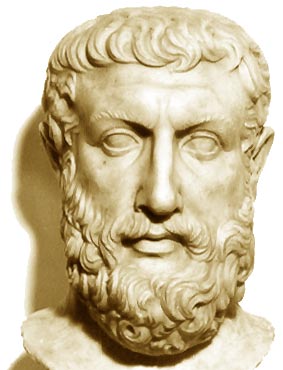
Greek Philosopher, Parmenides
The Congressional Budget Office unfortunately (and somewhat by design) winds up employing this fallacy constantly in its cost estimates of new programs.  Take, for instance their recent cost estimates of the latest iteration of the "Health Care Reform" bill up for a vote this week.  The CBO's estimates were somewhat positive for the supporting politicians because they tentatively said that - if there were additional scheduled cuts that actually happen the way the sponsors claim - the bill will reduce deficits by hundreds of billions of dollars over ten years.  Great news right?

Well... No, actually.

One of the problems with the CBO is that they are extrapolating the future demand on the nation's health care resources based on today's demand.  But as Dan Mitchell of the Cato Institute points out, this is a very bad plan indeed:
"The CBO has a very dismal track record of getting the numbers wrong, in part because there is no attempt to measure how a bigger burden of government has negative macroeconomic effects, but also because the number crunchers do a poor job of measuring the degree to which people (recipients, health care providers, state and local politicians, etc.) will modify their behavior to become eligible for other people’s money. The problem is compounded by similar mistakes for revenue estimates from the Joint Committee on Taxation, which (like CBO) makes no attempt to capture macroeconomic effects and has a less-than-stellar history of predicting behavioral responses."
And thus, we have the Parmenides' Fallacy working right before our eyes.

The Congressional Budget Office is looking at the current state of affairs (the amount of health care resources used per person when individuals still - even to a comparatively small degree from what would exist in an actual market-based health care system - are responsible for paying for their own treatment), and assuming future conditions based on the present.

The trouble is, when health care is believed to be "free", the behavior of the average health care consumer will drastically change.

It's a fundamental principle of economics, and easily observable reality in human nature, that when something is free people consume more of it.  Now, there are often arguments made that "Well, no one plans to get sick, so the idea that they're going to just break their own legs or injure themselves so they can go to the doctor more is absurd".

True enough.  But those arguments miss the point.

What will go up, as has done already with increasing government involvement in health care over the last 50 years, is the frequency with which people go to the doctor even for unnecessary problems, the level of drugs (prescription vs. generic, for instance) they purchase, the number of tests run per visit and other activities that propel costs higher & higher each year.  When the "someone else" is paying for their health care, people - both doctors & patients - on average are much less discriminating on what they actually need to spend their money on and rather go for basically everything possible.  Someone else is footing the bill, so why not?

The problem is that this mentality puts an enormous strain on the finite medical resources of the nation, and as a result, prices rise and access becomes more and more limited.  Of course, by setting terms carefully, insurance companies can limit this behavior to a degree currently, though not that much unfortunately, as there are a lot of restrictions already on those companies divorcing price from the end consumer.  Plus, about 50% of all health care is paid by the government already, further compounding the problem...  But the new health care legislation will change that situation entirely, warping the incentive structure even further towards a disconnect between price of goods & available supply - and the CBO doesn't really take that into account.

The CBO is making a crucial error in the way they calculate costs, and to a large extent, we can't even blame them for it! The system itself leads to this very problem... Politicians don't offer a dozen different bills for the CBO to compare & contrast, they offer them one bill at a time, and deliberately ask them to compare the future with that legislation to the present... The system promotes the fallacy.

And that's not the only problem, by the way!

Politicians are doing everything they can to game the system and use accounting tricks to skew the numbers.  It's no surprise that people who have vested interests in getting bills passed will manipulate the numbers a much as possible to make the bills more tenable.  This is especially true when we're talking about legislation that adds $1 Trillion in new government spending (from what source this magical trillion dollars comes from I still haven't the slightest clue!) in the middle of a severe global economic recession.

The Congressional Budget Office has no choice but to calculate future costs based on the data presented to them by politicians writing new legislation.  And like the rest of us, the folks who make up the CBO aren't psychic and can't predict the future.  When a politician says that in the future, other programs will be cut & salaries reduced, etc. to pay for this massive new entitlement expenditure, the CBO has to take that politician at his word and include that in their analysis...  Even when the entirety of human history shows that governments the world over never makes good on such promises.

As Michael Cannon (also at Cato) discussed recently as well, there are a ton of completely obvious problems with the political math already anyway simply due to politicians using their knowledge of how the CBO process works to game the system itself.  For example:
"As former Congressional Budget Office director Donald Marron has explained over and over, the figure that Democrats consistently cite for the cost of their bills is only the CBO’s estimate of the cost of federal spending related to the expansion of health insurance coverage.  It is not the full cost to the federal government, because each bill also spends taxpayer dollars on other items.
...
Moreover, the on-budget costs of the legislation probably account for only 40 percent of the total costs.  The other 60 percent come from the private-sector mandates.  But Democrats have systematically suppressed any estimates of those hidden taxes, probably because such an estimate would reveal the full cost of the legislation to be closer to $2.5 trillion over the next 10 years."
So in truth, while it seems like I'm railing against the Congressional Budget Office, I'm really not...

I think they're doing the best they can, and probably the best job any country could hope for in the field of analyzing the future costs of government... But their job is, at root, completely impossible.  Even at their absolute best, their numbers will still always be wrong... And I think this all goes into why there can be no rational economic calculation with government.

It's not the CBO's fault, but with politicians busy playing fast & loose with the numbers and using tricks to hide the truth of how much the American citizens are going to be on the hook for in the coming years, the very nature of how our cost-estimating agency operates pushes it into accepting a pretty serious logical fallacy as the basis for it's predictions.

The thing the CBO really needs to be doing primarily is reviewing multiple courses of action and assessing their relative merits in the future against other possible futures.

What will health care cost if we do nothing based on current estimates?  What will happen to that number if so-called "Health Care Reform" is passed?  What will happen to that number if real reform happened instead?  It's useless to view the future and say it's better or worse than today - of course it will be, one way or another.  What isn't useless is trying to determine which of many possible futures are going to bring about the best results and then using that knowledge to pursue intelligent courses of action.

Of course, this actually requires people at the CBO and within the government in general think more like decent economists and weigh options - but this isn't really a possibility.  They are charged only with reviewing legislation as it comes to them, not with producing alternatives... And the political process would never give them the time or latitude they'd need to accept 100 different plans (which aren't designed simply to game their review process) and then analyze each plan and legitimately compare one future to other possible future alternatives.

The asinine thing about the current health care legislation is that even if it were true that this particular iteration would reduce budget deficits over 10 years (and believe me, it isn't), it's *not* true in any case that the bill as it is is the best possible way of accomplishing that.  Comparing a future where we reduce some deficits to the present or the results of the present course we're on may show improvement, but assessing the future based on what is currently happening is a fallacy precisely because it precludes the possibility that there are other possible futures which would be even better.

This is a common theme with government, and a huge point of contention with free market economists and myself.  Politicians claim, for instance, that bailouts have saved millions of jobs and that we should be thankful because we would have lost more than we have if we had "done nothing".  However, I would contend that had we followed the prescription set out by folks like Ron Paul, and let the artificial bubble collapse quickly and help adjustments in the market with streamlined bankruptcy proceedings, and clear processes and even-handed application of the law to prevent theft & fraud... Not only would we have even more jobs today than we do, the correction would be over by now and the country wouldn't be in the grips of a depression, and businesses wouldn't be constantly leaving the US for more easily navigable climates - such as Singapore.

But that possible future was ignored two years ago, and we are now stuck hearing the President tell us how bad things would be today if they had "done nothing" - which is a conveniently unfalsifiable statement, since we can't just travel to another universe where the government actually embraced liberty in a time of crisis - but he doesn't bother to point out how much better things would be had they done the right things...

(I feel compelled to note here that the same Parmenides' Fallacy applies to proposed climate change legislation too, by the way... But you can ponder that one on your own.)

But back to the topic at hand... One way or another, the cost savings are a lie, but politicians can point to the present state of affairs and say that in 10 years with health care, they're going to "save" $100 Billion (after spending $2.5 Trillion, of course).  Sounds great, until you realize that if they actually took a market based approach they would not only not have to spend $2.5 Trillion in the first place, but would actually wind up reducing the cost of health care around the United States significantly and save many hundreds of billions of dollars, or even trillions, for real.

However, because they employ the Parmenides Fallacy - we don't actually get presented with that option.

The way it is all presented to the public is that there is essentially only one alternative, and our choice is stay with things exactly as they are or agree to a plan that politicians would have us believe will be marginally better than the present condition.  And we're supposed to cheer our great leaders for their bravery.

It's kind of an insidious fallacy in a way simply because it's very subtle and requires a depth of thought that a lot of people don't really have to get around.  It's just not enough to be able to think "If I do X, will that make me better off than I am today in 10 years?". We must also, and more importantly think, "If I do X, Y, or Z - which of these will make me best off compared to each other in the long run?"

The CBO, and more importantly our Congress, never do this... And even if that task were remotely easy to do, the system is designed so that they can't.

Monday, March 1, 2010

TED: 21st Century Motivation

Dan Pink discusses the (social) science of motivation at TED:


Watch the video first, and then I have some points to make... Done?  All right then.

Dan Pink makes some fantastic points throughout this speech, yet as surprised as he believes I should be and assumes that everyone else in the room is to learn this shocking "new" information, I am completely and uniformly... not.

Why not, you ask?

Am I some kind of super-genius who knows more than sociological researchers or Nobel laureate economists from the London School or the University of Chicago?  Probably not.

However, I would suggest that it is possible that I have an understanding of incentives (motivations) & economics that Dan Pink at least, and possibly those other folks, simply have not taken into consideration.  For those who didn't actually watch the video like you were supposed to, Mr. Pink explains that for certain types of jobs - specifically creative or "right brained" jobs which require intelligent, cognitive problem solving as opposed to more mechanically repetitive jobs - the "standard" incentives of higher wages or disincentives of being fired don't actually work.

And he's not just saying that they don't work well... He's saying that they actually work almost completely the opposite of their intended purpose to the extent that they are tried.  In consistent social experiments, Dan notes that sociological researchers are finding that in creative problem-solving situations, offering people more money to do a job faster actually correlated to poorer performance than people who are offered lower rates of pay.

Seems odd, right?  Dan certainly thinks so.

But I don't.  At all.  You see, it seems odd only if your conception of incentives is purely financial or monetary.

Clearly, that's what Dan is referencing and is the one major flaw he seems to repeat throughout this speech.  It's also a stereotype of economists and so-called "free market" supporters that is actually completely untenable, and is why I've decided to write about this today.

The premise of his talk is that "science knows" that people don't actually respond to incentives in the way economists and (many, but definitely not all) businesses believe...  While he's certainly right that the business environment is changing for Americans in the 21st Century into areas which "traditional" financial incentives have less meaning for employees, he actually makes no challenge what-so-ever to the assertion that people respond to incentives, which is sort of the revelation he's trying to support.  What's more, essentially his entire speech at TED actually supports the basic Misesian "Action Axiom" instead, summed up as follows:
"Action is the purposeful employment of means to achieve ends in accord with the actor's values."
Note the crucial qualifier: "in accord with the actor's values."

...Not the proscribed values of researchers, not the values of other people...  The values of those individuals doing the action and no one else.

Where Mr. Pink gets confused is that his conception of what constitutes an "incentive" has been grossly narrowed to include only the kinds of ideas bandied about by the same types of economists who are hung up on aggregating supply, demand and every other market process in order to quantify & create fancy, elegant and entirely useless macroeconomic statistical models.  What's worse, is that he pushes this false assumption onto both the audience (who for all I know share his misconception) and to essentially all economists.

For example:

Dan discusses the success of Wikipedia over Microsoft Encarta in the mid-1990s, noting that Microsoft did everything "right" according to what people thought about incentives at that time.  They hired writers, management, paid everyone well and yet Encarta is used by almost no one, and Wiki is obviously the go-to source for just about everyone today.  Dan says that;
"Ten years ago you could not have found a single, sober, economist anywhere on planet Earth who would have predicted the Wikipedia model."
But he's wrong about that.  Extremely wrong, in fact.  He's failed to take the Austrian School into account on this point, and the entire speech is unwittingly an ode to Ludwig von Mises' beautiful treatise, "Human Action" (PDF) first published in 1949... Undercutting the above statement severely.

I suppose in all fairness, many economists don't exactly view the Austrian crowd as "sober", but that's a discussion for another day, and I doubt Mr. Pink would quibble over that point anyway...

On the issue of human motivation, however, anyone who's remotely familiar with the Austrian School of Economics (which has been around over 100 years and has successfully predicted and clearly explained many major economic events, such as the Great Depression, the steep rise in inflation since the 70s, various shortages and bubbles & even the current economic catastrophe) should be explicitly aware that the school's views are completely in line with "the science" being reported on at TED, and always have been.

I would go so far as to suggest that had Mr. Pink approached any economist from Walter BlockBob Murphy or Mark Thornton all the way to even a few non-Austrians like George Mason University's Walter Williams or the brilliant Monetarist, Thomas Sowell, and said, "Would you believe that an encyclopedia who's only rewards for contribution were the satisfaction of writing about a topic you are interested in could out-compete a professional highly paid encyclopedia like Encarta?" and I can almost guarantee that every single one of them would have resoundingly said, "Of course!"

This is because, for any economist who actually understands the nature of subjective value (which is the whole deal with the Austrian School), the question is already answered within the premise.  Do the people contributing value the reward they're being offered - in this case, international publication in subject areas they are acutely passionate about?  YES... Immensely!  Is the reward monetary? Not at all.

What's even more amusing (to me) in the Wikipedia example is that the founder of Wikipedia, Jimmy Wales, is a pretty hard core Objectivist-leaning libertarian!  Funny how it's always the libertarian crowd who winds up correctly anticipating the way real humans are actually going to behave in the real world.  It's endlessly perplexing to me how "we" wind up getting told repeatedly that we're crazy, only to be completely vindicated in our views a little while later... Of course, after being vindicated, we just go on to being called "nuts" about something else.  Good times.

But I digress...

The lesson to learn here is one I've written about repeatedly on this blog.  The goal of economic activity isn't to arbitrarily move around some quantity of dollar bills from one party to another... It is instead to tangibly improve the lives of all parties involved in the exchange - based solely on the judgment of those individuals involved.

And that... is the fundamental point here.

Understanding that human beings act to pursue things that they value, and that values are subjective and dependent entirely on the individual in question means that monetary incentives are most definitely not the only types of incentives people are going to respond to.  It should also come as no surprise that people with higher levels of intelligence, skills and the ability to creatively solve intellectual and artistic problems for a living are motivated far less by monetary concerns (which we can usually assume they've largely already secured) and far more by the pursuit of besting challenges and rewarding experiences.

As Dan Pink puts it, people are looking for "Autonomy, Mastery & Purpose ".

That they are, Dan... That they are...

Additionally, the last few decades of American culture has shifted employment towards precisely these kinds of incentives.  Granted, it's not all that widespread yet, but the internet is making it possible for people to work from home, and many companies are doing exactly that with their employees.  In fact, as noted a few weeks ago, Tim Ferriss wrote a book advocating such things.

At any rate, I think that the vast majority of what Dan Pink says in that video is awesome.  It falls right in line with what I've observed about human nature since I was a kid, and it doesn't surprise me to find that experiments are backing up that observation consistently.  But unlike the so-called "Behavioral Economics" crowd (who on this issue are a lot like 15 year olds hearing Led Zepplin for the first time), I am under no delusions that I'm the first person in the world ever to figure this out.

Daniel Pink could do with a serious reading of Human Action.  Had he gone into this talk with an understanding of the Austrian School position, and certainly with more knowledge of Ludwig von Mises' work, he might not have made the foolish claims about economists that he did, and more importantly, he might have better understood that not only are people not behaving unpredictably or surprisingly... They are, in fact, behaving perfectly in line with what any decent observers of human action would expect.