Showing posts with label Fallacies. Show all posts

Sunday, October 30, 2011

Robert Reich: Clear, Simple & Wrong

By now, you have probably seen Robert Reich's cobbled together series of weak talking points cut together in a video mistitled "The Truth About The Economy". Honestly, I haven't written too much on Robert Reich, but today (by which I mean - at this point - 3 months ago!) my buddy Isaac did a breif point-by-point dismantling of Reich's video... which, in case you haven't seen it, looks a lot like this:


Now... Here's Isaac:
1) "Since 1980, the American economy has almost doubled in size."

I'm presuming he means GDP? I don't know where he gets this:

Absolute GDP growth:

http://data.worldbank.org/indicator/NY.GDP.MKTP.KD.ZG/countries/US?display=graph

Per capita GDP growth:

http://data.worldbank.org/indicator/NY.GDP.PCAP.KD.ZG/countries/US?display=graph

2) "Since 1980, most people's wages have hardly increased"

Wrong:

http://visualecon.wpengine .netdna-cdn.com/wp-content/uploads/2008/05/avg-income-2006.jpg

2) "Almost all of the gains have gone to the super rich"

This is misleading if you just look at raw numbers and averages:

The lower quartiles have actually experienced a faster growth of income than the rich, if you track individuals over time.

http://www.youtube.com/wat ch?v=vDhcqua3_W8

3) "All this wealth has given the rich lots of power, including the power to lower their tax rates."

True, the super rich do exercise a gross amount of political power, but I think there's a chicken and egg problem here. Most of the extremely wealthy families have been so for some time and have been exercising political power for at least as long. It's a self-feeding cycle, but I think his implication is that "these people got rich without government and then manipulated government." That certainly is true some of the time, but many of those wealthy families got rich *by* manipulating government power.

4) "This leads to huge budget deficits"

The idea that the only reason we have budget deficits is because the rich have lower tax rates is (sorry) FUCKING RETARDED. You could tax the rich 100% and *still* not cover the deficits our government is facing.

http://freerepublic.com/fo cus/f-news/2688472/posts

5) "Instead of joining together for better wages and jobs many people are so scared that they're competing with other working people for the scraps that are left behind."

Uh, what? Firstly, being "scared" has nothing to do with labor competition. People compete for jobs because it's the natural thing to do. Improve your skills, education, etc. Apply for better jobs. What exactly does this guy expect people to do? Politely step out of the way so someone else can have that job? How does that even work?

Secondly, the whole "scraps left behind" thing just screams zero-sum game reasoning, which jobs are not.

"So we get union vs. non-union... public vs private"

Ohh, he wants everyone to unionize... Right, because union states are doing *so well* against non-union states.

http://www.safehaven.com/a rticle/21577/jobs-income-data-show-right-to-work-states-have-advantage

6) "The vast middle class unable to borrow as it could before no longer has the purchasing power needed to get the economy growing again."

Firstly, I'm not convinced that the middle class is unable to borrow. I can't find any stats either way. But this is sort of beside the point. Purchasing power comes from income and savings, not borrowing. Borrowing only allows you to spend now what you'll have later, with a net *decrease* in total purchasing power (due to interest). The idea that borrowing is essential to economic growth is absurd.

And now for a little ad hom :P

http://mises.org/daily/733
I have virtually nothing to add here, but I will say that a week or so ago, Reich's video made it around my new office and all the Economic Freedom team people were both moderately irritated by Reich's willingness to play fast & loose with the facts, and to gloss over important details like income mobility; while also being a little shocked that the thing has been viewed by so many people.

Neither of those things surprises me, though. In fact, to a degree, they are related.

HL Mencken said:
"For every complex problem there is an answer that is clear, simple, and wrong."
And when Former Secretary of Labor, Robert Reich claims to be able to explain what's going on with the economy in 2 minutes... You can be sure that his clear, simple solution is just... Wrong. Way wrong, in fact.

Keynesian & other mainstream economists who rely heavily on macroeconomic modeling always make the mistake of operating far too much with aggregates and rarely dig into the details of their data sets in ways that they really need to do to actually understand what's going on.

Smooooooooooth.
So much of economics works that way, though. If you look at general statistics on compensation for men vs. women, you find that women make around 75% of what men make. Except, when you dig into the details and start controlling for hours worked, amount of time spent at the same job or in the same profession, full time vs. part time employees and marital/child status of men & women you find that that pay discrepancy disappears. This is how we should all know how to weed out bad economists from good ones.

Guys like Reich will take an incredibly complex national or even global economy and reduce it to a handful of aggregate numbers, and then make false conclusions without actually understanding the human elements operating within that system. No accounting is made for incentives, for the effect that monetary expansion and low interest rates - not to mention the numerous regulations and subsidies government has put in place - have on creating bubbles and their subsequent crashes.

Human action matters. Incentives matter. And aggregating all your data and drawing stupidly simplistic conclusions isn't a good way to do economics. Use all the math and the statistics you want, but you have to understand that these things are devoid of context and given the right inputs, you can get whatever output you want... Simply because the data sets are too big and the variables far too numerous to actually do anything meaningful with without zooming in.

Reich needs to zoom in.

But the tragedy here is that the video Reich made is incredibly convincing for people who are looking for an easy answer, and looking for a scapegoat and finding ways to blame their own dissatisfaction with their situation on someone else. As a video producer, I'm always looking for good ways of explaining and characterizing information in ways that are effective and convincing to people with no knowledge of economics.

Unfortunately, as one of my coworkers put it regarding Reich's video; the take-away from this video is that if you're willing to toss out reality, you can get a lot of views.

Note: This blog was originally drafted in July... But the demands of my job at the time prevented me from completing it. I'm just now catching up.

Saturday, March 20, 2010

The Parmenides' Fallacy in Health Care

A couple days ago, my beautiful, and extremely brilliant girlfriend was talking to me about a somewhat rarely considered logical fallacy called the Parmenides' Fallacy...

As I discovered, there is actually a blog (sort of) devoted to this particular fallacy, and the authors of that blog reference Prof. Philip Bobbitt, who coined the term.  Bobbitt's explanation is as follows:
"The Parmenides' Fallacy occurs when one tries to assess a future state of affairs by measuring it against the present, as opposed to comparing it to other possible futures.”
Elegantly said, I think.

The fallacy is probably one of the most widely employed by people in all walks of life, and one of the least discussed or known (perhaps because it was so recently coined).  It is also a bit hard to wrap one's head around, so let me provide an example of how this logical problem plays out in the real world.

...And for that there is no better example than the government's own financial prediction organization, the Congressional Budget Office.

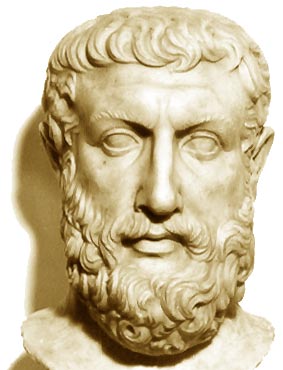
Greek Philosopher, Parmenides
The Congressional Budget Office unfortunately (and somewhat by design) winds up employing this fallacy constantly in its cost estimates of new programs.  Take, for instance their recent cost estimates of the latest iteration of the "Health Care Reform" bill up for a vote this week.  The CBO's estimates were somewhat positive for the supporting politicians because they tentatively said that - if there were additional scheduled cuts that actually happen the way the sponsors claim - the bill will reduce deficits by hundreds of billions of dollars over ten years.  Great news right?

Well... No, actually.

One of the problems with the CBO is that they are extrapolating the future demand on the nation's health care resources based on today's demand.  But as Dan Mitchell of the Cato Institute points out, this is a very bad plan indeed:
"The CBO has a very dismal track record of getting the numbers wrong, in part because there is no attempt to measure how a bigger burden of government has negative macroeconomic effects, but also because the number crunchers do a poor job of measuring the degree to which people (recipients, health care providers, state and local politicians, etc.) will modify their behavior to become eligible for other people’s money. The problem is compounded by similar mistakes for revenue estimates from the Joint Committee on Taxation, which (like CBO) makes no attempt to capture macroeconomic effects and has a less-than-stellar history of predicting behavioral responses."
And thus, we have the Parmenides' Fallacy working right before our eyes.

The Congressional Budget Office is looking at the current state of affairs (the amount of health care resources used per person when individuals still - even to a comparatively small degree from what would exist in an actual market-based health care system - are responsible for paying for their own treatment), and assuming future conditions based on the present.

The trouble is, when health care is believed to be "free", the behavior of the average health care consumer will drastically change.

It's a fundamental principle of economics, and easily observable reality in human nature, that when something is free people consume more of it.  Now, there are often arguments made that "Well, no one plans to get sick, so the idea that they're going to just break their own legs or injure themselves so they can go to the doctor more is absurd".

True enough.  But those arguments miss the point.

What will go up, as has done already with increasing government involvement in health care over the last 50 years, is the frequency with which people go to the doctor even for unnecessary problems, the level of drugs (prescription vs. generic, for instance) they purchase, the number of tests run per visit and other activities that propel costs higher & higher each year.  When the "someone else" is paying for their health care, people - both doctors & patients - on average are much less discriminating on what they actually need to spend their money on and rather go for basically everything possible.  Someone else is footing the bill, so why not?

The problem is that this mentality puts an enormous strain on the finite medical resources of the nation, and as a result, prices rise and access becomes more and more limited.  Of course, by setting terms carefully, insurance companies can limit this behavior to a degree currently, though not that much unfortunately, as there are a lot of restrictions already on those companies divorcing price from the end consumer.  Plus, about 50% of all health care is paid by the government already, further compounding the problem...  But the new health care legislation will change that situation entirely, warping the incentive structure even further towards a disconnect between price of goods & available supply - and the CBO doesn't really take that into account.

The CBO is making a crucial error in the way they calculate costs, and to a large extent, we can't even blame them for it! The system itself leads to this very problem... Politicians don't offer a dozen different bills for the CBO to compare & contrast, they offer them one bill at a time, and deliberately ask them to compare the future with that legislation to the present... The system promotes the fallacy.

And that's not the only problem, by the way!

Politicians are doing everything they can to game the system and use accounting tricks to skew the numbers.  It's no surprise that people who have vested interests in getting bills passed will manipulate the numbers a much as possible to make the bills more tenable.  This is especially true when we're talking about legislation that adds $1 Trillion in new government spending (from what source this magical trillion dollars comes from I still haven't the slightest clue!) in the middle of a severe global economic recession.

The Congressional Budget Office has no choice but to calculate future costs based on the data presented to them by politicians writing new legislation.  And like the rest of us, the folks who make up the CBO aren't psychic and can't predict the future.  When a politician says that in the future, other programs will be cut & salaries reduced, etc. to pay for this massive new entitlement expenditure, the CBO has to take that politician at his word and include that in their analysis...  Even when the entirety of human history shows that governments the world over never makes good on such promises.

As Michael Cannon (also at Cato) discussed recently as well, there are a ton of completely obvious problems with the political math already anyway simply due to politicians using their knowledge of how the CBO process works to game the system itself.  For example:
"As former Congressional Budget Office director Donald Marron has explained over and over, the figure that Democrats consistently cite for the cost of their bills is only the CBO’s estimate of the cost of federal spending related to the expansion of health insurance coverage.  It is not the full cost to the federal government, because each bill also spends taxpayer dollars on other items.
...
Moreover, the on-budget costs of the legislation probably account for only 40 percent of the total costs.  The other 60 percent come from the private-sector mandates.  But Democrats have systematically suppressed any estimates of those hidden taxes, probably because such an estimate would reveal the full cost of the legislation to be closer to $2.5 trillion over the next 10 years."
So in truth, while it seems like I'm railing against the Congressional Budget Office, I'm really not...

I think they're doing the best they can, and probably the best job any country could hope for in the field of analyzing the future costs of government... But their job is, at root, completely impossible.  Even at their absolute best, their numbers will still always be wrong... And I think this all goes into why there can be no rational economic calculation with government.

It's not the CBO's fault, but with politicians busy playing fast & loose with the numbers and using tricks to hide the truth of how much the American citizens are going to be on the hook for in the coming years, the very nature of how our cost-estimating agency operates pushes it into accepting a pretty serious logical fallacy as the basis for it's predictions.

The thing the CBO really needs to be doing primarily is reviewing multiple courses of action and assessing their relative merits in the future against other possible futures.

What will health care cost if we do nothing based on current estimates?  What will happen to that number if so-called "Health Care Reform" is passed?  What will happen to that number if real reform happened instead?  It's useless to view the future and say it's better or worse than today - of course it will be, one way or another.  What isn't useless is trying to determine which of many possible futures are going to bring about the best results and then using that knowledge to pursue intelligent courses of action.

Of course, this actually requires people at the CBO and within the government in general think more like decent economists and weigh options - but this isn't really a possibility.  They are charged only with reviewing legislation as it comes to them, not with producing alternatives... And the political process would never give them the time or latitude they'd need to accept 100 different plans (which aren't designed simply to game their review process) and then analyze each plan and legitimately compare one future to other possible future alternatives.

The asinine thing about the current health care legislation is that even if it were true that this particular iteration would reduce budget deficits over 10 years (and believe me, it isn't), it's *not* true in any case that the bill as it is is the best possible way of accomplishing that.  Comparing a future where we reduce some deficits to the present or the results of the present course we're on may show improvement, but assessing the future based on what is currently happening is a fallacy precisely because it precludes the possibility that there are other possible futures which would be even better.

This is a common theme with government, and a huge point of contention with free market economists and myself.  Politicians claim, for instance, that bailouts have saved millions of jobs and that we should be thankful because we would have lost more than we have if we had "done nothing".  However, I would contend that had we followed the prescription set out by folks like Ron Paul, and let the artificial bubble collapse quickly and help adjustments in the market with streamlined bankruptcy proceedings, and clear processes and even-handed application of the law to prevent theft & fraud... Not only would we have even more jobs today than we do, the correction would be over by now and the country wouldn't be in the grips of a depression, and businesses wouldn't be constantly leaving the US for more easily navigable climates - such as Singapore.

But that possible future was ignored two years ago, and we are now stuck hearing the President tell us how bad things would be today if they had "done nothing" - which is a conveniently unfalsifiable statement, since we can't just travel to another universe where the government actually embraced liberty in a time of crisis - but he doesn't bother to point out how much better things would be had they done the right things...

(I feel compelled to note here that the same Parmenides' Fallacy applies to proposed climate change legislation too, by the way... But you can ponder that one on your own.)

But back to the topic at hand... One way or another, the cost savings are a lie, but politicians can point to the present state of affairs and say that in 10 years with health care, they're going to "save" $100 Billion (after spending $2.5 Trillion, of course).  Sounds great, until you realize that if they actually took a market based approach they would not only not have to spend $2.5 Trillion in the first place, but would actually wind up reducing the cost of health care around the United States significantly and save many hundreds of billions of dollars, or even trillions, for real.

However, because they employ the Parmenides Fallacy - we don't actually get presented with that option.

The way it is all presented to the public is that there is essentially only one alternative, and our choice is stay with things exactly as they are or agree to a plan that politicians would have us believe will be marginally better than the present condition.  And we're supposed to cheer our great leaders for their bravery.

It's kind of an insidious fallacy in a way simply because it's very subtle and requires a depth of thought that a lot of people don't really have to get around.  It's just not enough to be able to think "If I do X, will that make me better off than I am today in 10 years?". We must also, and more importantly think, "If I do X, Y, or Z - which of these will make me best off compared to each other in the long run?"

The CBO, and more importantly our Congress, never do this... And even if that task were remotely easy to do, the system is designed so that they can't.

Saturday, March 6, 2010

The Prisoner's Dilemma and Other Games

I want to briefly talk about the Prisoner's Dilemma...


For those who don't know what that is, let me quote wiki:
"In its classical form, the prisoner's dilemma ("PD") is presented as follows:
Two suspects are arrested by the police. The police have insufficient evidence for a conviction, and, having separated both prisoners, visit each of them to offer the same deal. If one testifies (defects from the other) for the prosecution against the other and the other remains silent (cooperates with the other), the betrayer goes free and the silent accomplice receives the full 10-year sentence. If both remain silent, both prisoners are sentenced to only six months in jail for a minor charge. If each betrays the other, each receives a five-year sentence. Each prisoner must choose to betray the other or to remain silent. Each one is assured that the other would not know about the betrayal before the end of the investigation.
How should the prisoners act?"
It goes on to say that we must:
"...assume that each player cares only about minimizing his or her own time in jail"
But why should we??


That's an arbitrary assumption to make based on a researcher or thought-experimenter's own values.  There are many situations which are easy to imagine where other values would be clearly dominant.


For example, in the real world being a "snitch" or being thought of as one carries extreme consequences to some criminals.  Some people also turn to crime because their alternatives are severely limited by their skills, education, social ability, personal history, intelligence or geography - and thus in some situations jail would offer an improvement to the perceived standard of living of some individuals.  Point is, there are thousands of such scenarios where the choice that game theorists define as the "optimal" solution wouldn't be the real one chosen by actual human beings.


As a result we get study after study claiming that people behave irrationally even though in reality their choices are directed by value-seeking behavior that just doesn't conform to the predicted value structure of the researchers.


However... Real life is always the baseline of what we should define as correct and theories which don't accurately describe real life need to be understood as false, or at least partly false.


Now you might think that this may be an example of question begging or circular logic since based on my above statements it would seem like I'm suggesting that irrational behavior is impossible.  As a matter of fact I do believe that irrational behavior is certainly possible but it should be defined as actions which go against a person's value-oriented goals.  In the above scenario, if a prisoner knew he was going to be murdered or injured for being a "snitch", and he did not want to be murdered, then he'd be irrational if he picked the option that led to that outcome.  Irrational behavior is possible... But the Prisoner's Dilemma actually really doesn't prove that point at all - and neither do most other game theory hypotheticals.


The trouble - from the standpoint of sociological research methodology - is that we can't actually know what the prisoner's values are.  We can make guesses and estimates, and we can even ask him (though it's dubious that he would tell any particularly intimate beliefs or feelings truthfully to researchers he doesn't even know), but ultimately human beings aren't blessed with the ability to read minds and as a result we are all in the dark about what others of our species are really after.


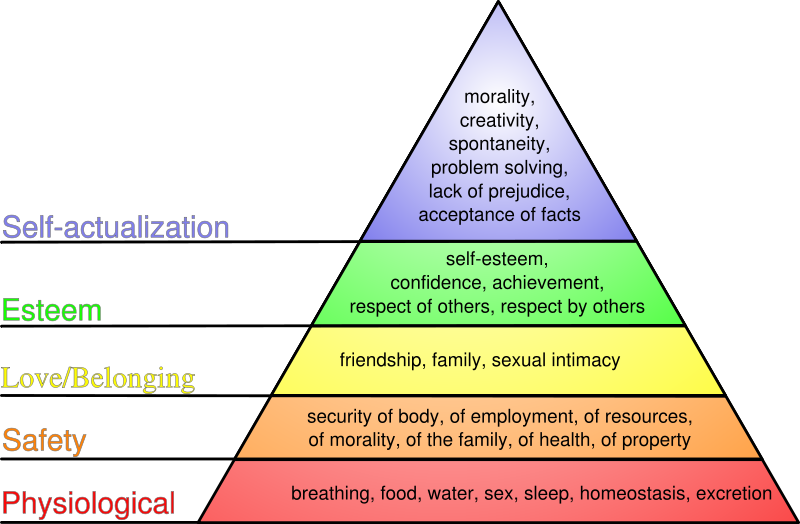
As a general rule, Abraham Maslow's hierarchy of needs is a good starting block:


But even the base is imperfect (some people wish to commit suicide, for instance), and once you make it into the emotional territories of Love & Belonging, Esteem and Self-actualization all bets are basically off as to what that means to different people.  You don't know what makes me happy and feel loved any more than I would be so presumptuous as to tell you what type of creativity suits you best.  It is in recognizing my ignorance on that point that a large pillar of my unwavering belief in freedom is founded.  I don't know what the best decisions for you are, and even if you make what I think are bad (or "irrational" based on my value judgment) choices from time to time, they are still yours to make.


Sometimes, researchers and perhaps more accurately lay people and science reporters need to simply be more aware of their intrinsic ignorance on these fronts.


Game theory is interesting and can be useful in some ways - but it's worth noting that we shouldn't take it as the be-all, end-all of understanding human behavior.  Likewise, any theory of societal organization, politics or economics that doesn't work in reality or is "utopian" in nature is just a bad theory.

Thursday, March 4, 2010

The False Belief in True Models

This whole post over at the Junk Charts blog is worthy of being on my blog and probably should have been written by me.

An excerpt:
"Unfortunately, Gross apparently did not speak with a statistician before writing this article. A statistical modeler would compute

REALITY - FORECAST = ERROR

which is different from the reporter's perspective that

REALITY - EXPECTATION = OVERPERFORMANCE (or UNDERPERFORMANCE)

What's the difference?

***

The statistician takes reality as the truth, and any deviation from reality as a modeling error while the reporter takes "expectation" (the forecasts) as the truth, and any deviation from expectation as overperformance (if positive) or underperformance (if negative). When the model's forecasts are treated as yardsticks for performance, one is assuming that the expectations are set correctly, which means the model can never be wrong!"
This phenomenon is startlingly and disappointingly common within all aspects of journalism and politics. In this blog post, the author (Kaiser Fung) is referring to the Olympic medal winning prediction models, but how often do we see exactly this logical error being made by reporters and politicians?  What's more disturbing is when you see these errors being made by other types of scientists and economists, and this happens pretty frequently!

For example, policy supposedly designed to combat global warming is entirely based on assumptions coming from predictive models which have often proven to be wildly inaccurate. Now, sure... Decent scientists will see the inaccurate model and say "Ok, how do I make this better?", but the reporter or politician will often implicitly suggest that in fact the model is correct and reality simply didn't match expectations for reasons unknown.  They then typically proceed to push through policy driven based on those failed models as "truth".  This represents a sort of blind faith in the infallibility of the model, even when it turns out to fail to reflect reality.

A point that Fung doesn't cover which I'd like to bring up, however, is that sometimes the very premise of building models via statistics is a flawed concept from the outset.

Unfortunately, most of modern (Neo-Keynesian) "macroeconomics" is based on exactly this fallacies.  When reality - for example the 2008 stock market crash - doesn't line up with the models, some scientists will go back and try to re-work their model to be more accurate at predicting future events... But what macroeconomists fail to understand is that economics is not about Keynesian "aggregates"... Economics deals with individual human action, which in turn is based on a wide array of unknowable (to researchers) values and motivations spurring those individuals to act in one way or another.

Building accurate models in economics would actually require economists to be able to plug in data from millions of variables (each individual) which they are absolutely not privy to.  This is why it's far better to view the whole field from the framework of axiomatic human action, than it is trying to aggregate all demand and all supply - and thus all individual decisions - into big lumps of "economic activity" that can be manipulated or controlled from on high.  It is also ironically why the folks who don't really view economics as "predictive" science (any more than an evolutionary biologist would feign to "predict" the next phase of evolution) are always the best at predicting future outcomes of current policy.

So anyway... Belief in the infallibility of models is a huge problem, but so is building statistical models in some cases & fields at all when that's entirely the wrong tool for understanding reality.